Ever considered an offline learning kit? Think about this: what happens when the Wi-Fi suddenly stops working, a storm knocks out the power, or a cybersecurity attack makes your child’s favorite online learning platform or your internet services unavailable for… who knows how long?
If your kids rely on the internet for schoolwork, homework, or educational activities, an unexpected web outage can quickly turn into a frustrating experience and even set your school schedule off course.
But, your kid’s learning doesn’t have to stop just because the internet does. With a little preparation, parents and teachers can create an offline learning kit filled with fun, educational activities that keep kids engaged, curious, and learning without internet access. HERE’S HOW…
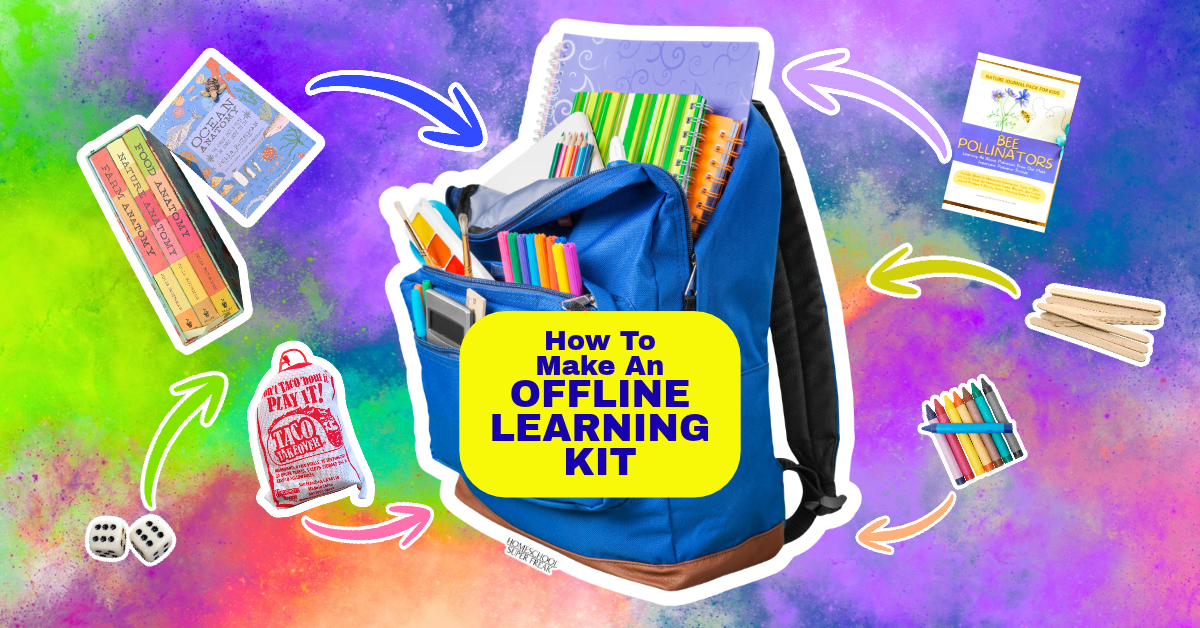
All About Creating An Educational Offline Learning Kit for Kids
Whether you’re preparing for emergencies, looking for screen-free learning activities, or simply want a backup plan for online education, offline learning kits should be in your planning and emergency prepping.
Preparing NOW to have an offline learning kit ready when you need it really can make all the difference between stressing out over education (during already stressful times) and creating a seamless (and even fun!) learning experience for kids during outages or hard times.
What Is an Offline Learning Kit?
An offline learning kit is a collection of educational materials, games, books, and hands-on activities that kids can use without Wi-Fi or an internet connection.
Think of this internet-free educational tool as a grab-and-go learning box or tote that makes it easy to keep kids busy and learning when online services aren’t available.
An offline education kit can be as simple as a tote filled with crayons & paper, flashcards, puzzles, card games, and a few books or as elaborate as a storage bin organized with learning activities by subjects.
The best part about offline learning kits?
You don’t need expensive supplies or special equipment to create one.
Many of the materials are probably already in your home or classroom!

Offline Educational Resources: Quick Tips To Prepare for Internet Outages
Having educational materials ready before an internet outage or emergency helps parents and teachers keep kids learning when online resources aren’t available.
- Create an offline learning kit: Include books, worksheets, puzzles, arts & crafts supplies, and educational games.
- Keep printed activity sheets: Prepare math exercises, reading activities, and writing prompts, coloring sheets & more by printing off different levels of worksheets.
- Use educational workbooks: Choose age-appropriate materials for independent study. TIP: Keep several different levels for kids who want to work ahead or need to drop back a little.
- Download resources in advance: Save educational PDFs, lessons, and videos for offline access when devices and power are available. TIP: I store A LOT of resources on an independent drive like this for offline resources.
- Prepare learning activity cards: Write simple educational challenges on index cards to have quick learning ideas for later.
- Create an emergency learning binder: Organize activities by subject and grade level (or by student if you homeschool) for easy access during disruptions.
Preparing before an emergency power outage or internet down situation is key!
Why Every Family and Classroom Needs an Offline Learning Kit (Whether You Homeschool or Not)
You may think I’m being all over-the-top zombie apocalypse scary, but consider that what just happened:
In October 2026, a critical security flaw was exposed in the software that runs almost 70% of the internet’s websites. This left all of those websites open to hackers.
Some companies and businesses across the world took their websites down to deal with the security updates, which meant wide ranges of information and access were unavailable.
This security flaw can cause ongoing issues and outages, including for websites where your child learns, where you store your information, or how you access resources.
We often take internet access for granted, especially when so much of today’s education depends on online assignments, educational apps, Youtube videos, and other digital learning platforms.
But there are plenty of situations when learning without internet becomes necessary (not just the zombie apocalypse):
Internet and Wi-Fi Outages
Internet connections can go down unexpectedly because of service interruptions, equipment problems, or severe weather.
Having offline educational resources available means kids can continue practicing important skills without waiting for the connection to return.
Power Outages and Emergencies
Storms, natural disasters, and other emergencies can interrupt electricity and internet service for hours or even days.
A collection of printed worksheets, books, and hands-on learning activities can provide familiar routines and engaging distractions during these disruptions, which can actually be calming for kids (and the entire family).
Cybersecurity Attacks and Online Learning Disruptions
Educational platforms can experience cybersecurity incident, including ransomware attacks, hacks, and data breaches, that temporarily make online learning tools unavailable.
An offline learning kit provides an alternative way for students to continue reading, writing, practicing math, and exploring new subjects without depending on digital platforms.
Reducing Screen Time
Even when the internet is working perfectly, taking a break from screens can be beneficial.
Offline learning activities encourage kids to explore their surroundings, use their imaginations, practice problem-solving, and interact with others.
Having a learning kit ready makes it easier to offer an educational alternative to another video or online game.

How To Make Offline Learning Kits for Internet Outages or Screen-Free Ideas
1. Decide How You Will Organize Your Offline Learning Kit
Before you do any of the fun stuff (like picking books and games), you need to decide how you will organize your offline educational kit.
Think about:
- Do you want to organize the kit by subject?
- Would you rather make an individual kit for each child / student?
- Are you more concerned about having a general emergency learning kit that all students can use that helps with any type of learning (and not just the specific schedule you’re on)?
- What will go in your learning kits? Do you want just their current worksheets or books and games, too? (This will help you decide how big of a container you need.)
For younger children, include picture-based instructions and simple activities.
Older kids may enjoy independent research projects, challenging puzzles, creative writing assignments, and hands-on experiments.
2. Make A Kit List
Before getting all your supplies, make a kit list of what you need.
You can do this overall by subjects or by each child.
If you’re making a learning kit for each child, make a list of things your child is learning about.
KIT TIP: Think macro and not micro for overall learning tools.
For example, if the student is doing geometry, maybe include this book and a geometry game like this. No matter where the student is when internet access went down they can still pick up continue learning without interruption.
If your less worried about subject or age, put together a kit where everyone can learn something at their own level.
For example, if you nature hike, younger kids can work on colors while older kids can work on writing with an observation nature journal from the kit.
LEARNING KIT TIP: You cannot go wrong with any of the Julia Rothman books. They’re cool enough to keep all ages interested. For some of the books, she even has companion activity books that are great for offline educational kits!
Making a educational kit list of supplies will help you better understand what type of kit container to use.
3. Choose a Container for Your Offline Learning Kit(s)
Start with something simple that can hold all your educational supplies. It needs to be more than a binder because you want it to be able to hold a binder (if you use it) as well as games, books, and supplies all in one place.
THINK: Grab and go.
A plastic storage bin with a lid works great.
If you are planning a kit for each child, a backpack or tote bag works well. (These are also great if you have to relocate in an emergency situation.)
Choose a container that’s easy to access but still large enough to hold books, worksheets, games, craft kits, and other learning materials.
Helpful tip: Keep your kit in a convenient location so you can grab it quickly and easily when the internet goes down or the power is out.
4. Don’t Forget an Offline Teacher Kit
Make a teaching kit for you that has a binder organized with information you need (like subject topics, each child’s learning schedule, checklists, etc.).
You can also put group games and group activities into your teaching kit.
KIT TIP: Keep a copy of student’s grades and schedules in your teacher kit in case you can’t get online.
Include in your kit: a charging device like this that can power up the hard drive or computer where you saved any offline resources.
5. Add Books and Reading Materials
Books are among the most valuable offline learning resources you can include.
They help kids build vocabulary, strengthen reading comprehension, explore new subjects, and develop a love of learning.
And, they’re not just for reading. You can use them for story scavenger hunts, recipes & reads, craft inspiration & so much more.

Book ideas for an offline educational kit:
- Both fiction and nonfiction books
- Living books
- Picture books and early readers (Picture books are great to read together during power outage or emergency times because they’re often funny and comforting.)
- Children’s magazines
- Dictionaries and illustrated encyclopedias
- Comics and graphic novels
- Activity books (these are some of our favs!) and reading comprehension worksheets
- Printed short stories and poems
Also, let kids help choose their reading materials. They’re more likely to enjoy offline reading activities when the topics match their interests.
Offline learning idea: Include a reading journal where kids can write about their favorite characters, interesting facts, or questions they have after reading.
6. Include Educational Games and Puzzles
Learning without Wi-Fi doesn’t mean kids have to sit quietly completing worksheets all day.
Educational games are a fun way to practice important skills while encouraging creativity, teamwork, and critical thinking.
Gameschooling is actually my favorite internet-free way to learn!

Some great screen-free educational games include:
- Regular playing cards for math and memory games
- Dice for counting, addition, and multiplication
- Flashcards for spelling, vocabulary, and math facts
- Crossword puzzles and word searches
- Sudoku and logic puzzles
- Small jigsaw puzzles
- Travel-sized board games (they take up less room)
- Printable educational bingo cards
KIT TIP: You can also create homemade games using index cards, paper, and markers, so you may want to have some blank note cards in your kit. Giving kids notecards, playing cards, and dice and asking them to create their own game to play with everyone is great for strategic thinking skills practice!
CHECK OUT THESE FUN GAMES FOR LEARNING:
- Top 10 Family Board Games In Our House
- Best Games For Science Learning That You’ve Never Heard Of!
- 17 Math Games That Are Cool & FUN To Play with Kids
- Learning Chess for Kids: Beginner Tips
- How To Play Dominoes
7. Prepare Printable Worksheets and Learning Activities
Printed educational worksheets and coloring sheets are especially helpful when online assignments and learning platforms aren’t available.
Before an internet outage happens, print a selection of activities covering different subjects and learning levels.
(Obviously, you don’t know when an internet outage will happen. That’s why you emergency prep now!)

Educational kit tip: Download our bee pollinator worksheet activity pack now and then play the pollinator game for offline educational ideas!
Consider educational materials for:
- Reading and Language Arts
- Reading comprehension exercises
- Vocabulary activities
- Spelling practice
- Creative writing prompts
- Math
- Addition, subtraction, multiplication, and division
- Fractions and decimals
- Word problems
- Math puzzles and number games
- Science
- Observation worksheets (great for nature walks during screen-free time!)
- Simple science experiments that you can do with supplies you have at home
- Nature scavenger hunts
- Scientific drawing activities
- Social Studies
- Map activities
- Geography challenges
- Historical timelines
- Life skills or community helper activities
Organize the worksheets into 3-ring folders so kids can easily find activities that interest them.
Helpful tip: Include a simple activity checklist so kids can write down and track what they’ve completed.
These DIY workbooks help kids practice different subjects for internet-free learning.
Helpful educational kit tip: Include a mix of easy, moderate, and challenging activities and alternate them to keep learning enjoyable rather than overwhelming.
8. Pack Art Supplies and Creative Learning Materials
Creative activities are a great way to encourage hands-on learning without technology and also a fun way to keep kids’ minds off of stressful situations (if the web is down because of emergencies).
You don’t need a huge collection of craft supplies to keep kids entertained and engaged.
Consider including hands-on things like:
- Crayons, colored pencils, and washable markers
- Construction paper
- Sketchbooks
- Mini craft kits like these
- Glue sticks
- Child-safe scissors
- Modeling clay
- Stickers
- Rulers
- Stencils
These supplies can be used for drawing, storytelling, designing inventions, making educational posters, building simple projects, or just keeping their mind of a stressful emergency situation.
Offline learning idea: Challenge kids to invent something that solves an everyday problem. Have them draw their invention, explain how it works, and build a model using available materials.
9. Add Hands-On STEM Learning Activities
STEM activities help kids explore science, technology, engineering, and math through experimentation and problem-solving.
Many hands-on STEM projects don’t require electricity, computers, or internet access.
Busy Bags like this are great for STEM!

Try including supplies for activities such as:
- Paper Airplane Challenges: Experiment with different airplane designs and measure how far they fly.
- Building Challenges: Use craft sticks, paper, or blocks to build bridges and towers. TIP: Craft sticks like these are cheap and easy to put in your learning kit and they can be used for so many things from STEM building, counting, games, crafts & MORE!
- Magnet Exploration: Test which household objects are attracted to magnets.
- Pattern Activities: Use beads, blocks, or colored paper to create and extend patterns.
- Simple Machines: Explore ramps and levers using household materials.
- Measurement Challenges: Practice measuring everyday objects and comparing their sizes.
Obviously, for younger children, choose age-appropriate supplies and avoid small objects that could pose choking hazards.
Offline learning idea: Include a science journal with space for kids to record their observations.
10. Create an Offline Learning Activity Jar
Sometimes the hardest part of learning without internet is deciding what to do next.
An activity jar solves that problem, especially when you plan ahead and get everyone involved.
Write different educational activities on slips of paper, fold them, and place them in a jar or small container.
When kids need something to do, they can choose a surprise learning challenge.
Here are a few ideas to get you started:
- Write a story about an imaginary adventure.
- Design your dream treehouse.
- Find five objects shaped like circles.
- Create a secret code and write a message.
- Build the tallest tower you can using paper.
- Make a list of ten things you want to learn.
- Invent a new board game.
- Write a letter to someone you admire.
- Draw a map of your neighborhood.
- Create a comic strip about your day.
These simple activities encourage independent learning and creativity without requiring screens or special equipment.
11. Don’t Forget About Everyday Life Skills Activities!

READ ABOUT THE IMPORTANCE OF COOKING WITH KIDS FOR LEARNING
Not every educational activity needs to look like a traditional school lesson or like it came from a textbook.
Some of the best learning experiences happen when kids practice real-world skills.
Add activity cards that encourage children to:
- Plan a meal using a pretend budget.
- Practice counting money and making change.
- Read a recipe and identify measurements.
- Create a daily schedule.
- Sort and organize household items (helllooooo all those socks!)
- Learn how to read an analog clock.
- Practice cursive.
- Practice writing addresses and letters on envelopes.
- Create a simple savings plan.
- Learn about emergency safety procedures for your family, house, and community.
These practical offline learning activities help kids develop independence, confidence, and problem-solving skills, which often get overlooked with traditional education.
12. Make an Offline Learning Plan Before You Need It
Having educational supplies ready is helpful, but creating a simple plan makes your offline learning kit even more useful, especially if you give it thought before an emergency outage and chaos and stress is taking over.
Prepare a flexible learning schedule that includes a variety of activities.
For example include a time and the activity to move you through the day (and use it as a loose guide):
- Offline Learning Activity: 9:00 AM
- Independent reading: 9:30 AM
- Math games or worksheets: 10:00 AM
- Creative arts or writing: 10:30 AM
- Movement break or nature outdoor activity: 11:00 AM
- Hands-on science or STEM challenge: 11:30 AM
- Educational board game or puzzle: After lunch
This schedule is only an example. Adjust activities based on your child’s age, interests, and circumstances. If it’s a stressful time, loosen up the schedule and learn in easy ways like playing games or reading together or coloring together.
IMPORTANT TIP: During emergencies, keep expectations flexible. The goal is to provide a sense of routine and enjoyable learning opportunities, not recreate an entire school day.
Updating Your Offline Learning Kit
Once you’ve created your kit, don’t forget about it!
Kids’ interests and educational needs change over time, so it’s helpful to review your supplies every few months.
After you make your offline educational kits, set a reminder for yourself to update it in 3-6 months.
Think about:
- Replacing completed worksheets
- Adding new books and activities
- Getting rid of things that didn’t work
- Checking that markers and glue haven’t dried out
- Updating learning materials for your child’s grade level
- Rotating puzzles and games to maintain interest
- Testing downloaded resources to make sure they still work offline
- Replacing missing or damaged supplies
You can also let kids help update their kits by choosing new activities or suggesting subjects they want to explore.
When children have a say in their learning materials, they’re often more excited to use them.
▶READ THIS NEXT: FAQs About Teaching Without Online Technology
Review: Quick Offline Learning Kit Checklist
Ready to create your own emergency learning kit?
Offline Learning Kit Checklist
Use this simple checklist to get started:
- Basic Supplies
- Storage bin, backpack, or tote
- Pencils, pens, and erasers
- Notebook or journal
- Blank paper and index cards
- Folders or binder
- Reading and Writing
- Books
- Reading comprehension activities
- Creative writing prompts
- Vocabulary and spelling games
- Math and Educational Games
- Playing cards and dice
- Math worksheets
- Flashcards
- Puzzles and brainteasers
- Small board games
- Creative and Hands-On Learning
- Art supplies
- STEM challenge cards
- Building materials
- Science observation sheets
- Activity jar
Optional Digital Resources To Access Now Before You Can’t
- Downloaded educational videos
- Offline learning apps
- Saved e-books and audiobooks
- Downloaded assignments
- Device charger or charged power bank
MORE EMERGENCY PREPAREDNESS RESOURCES:
50 Best Emergency Preparedness Lesson Plans and Activities for Kids of All Ages Preschool to K12
How To Prepare for Winter Food Shortages This Year
16 Unexpected Items Every Emergency Go Bag for Kids Should Have (#5 Is a Game-Changer!)
Be sure to get started making your offline learning kit TODAY!